
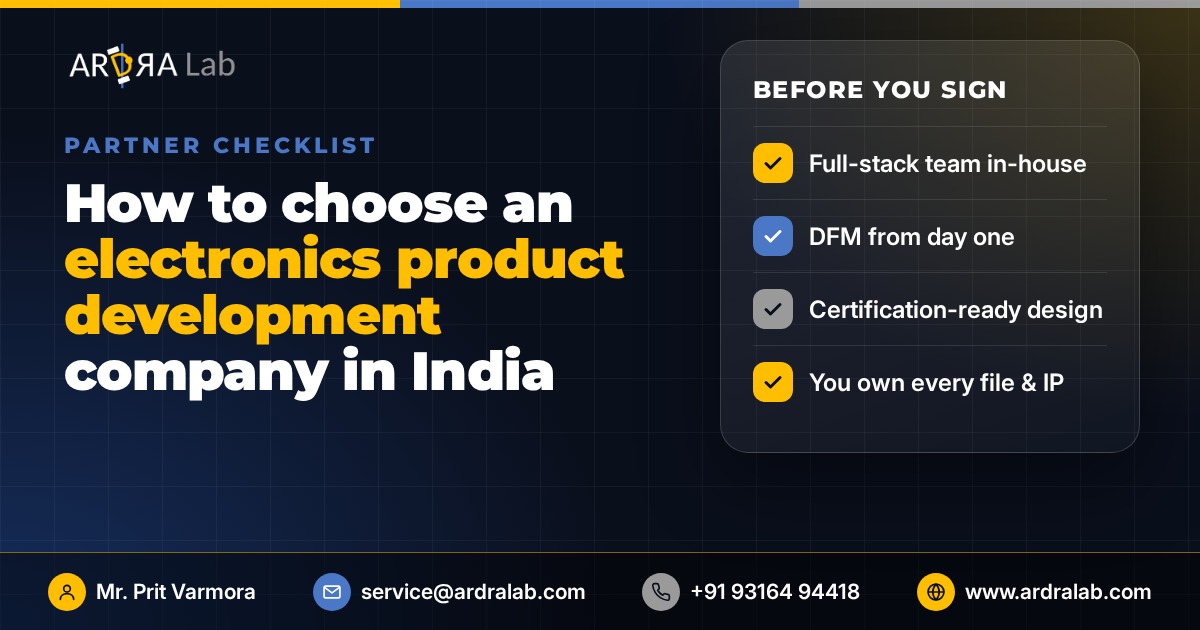
For a hardware company, the choice of development partner is rarely a small decision. It quietly sets your time-to-market, your unit cost, your certification risk and, often, whether version one ever reaches a customer. A good partner shortens the path from idea to production. The wrong one turns a six-month plan into an eighteen-month rescue project.
India has become one of the strongest places in the world to build electronics products, with deep engineering talent, a growing component ecosystem and competitive costs. That also means there are many firms to choose from, and on paper they all look alike. This checklist is for business owners and product teams who need to tell the difference before they sign.
1. Full-stack capability under one roof
A connected device is never just a circuit board. It is hardware, firmware, PCB layout, enclosure fit, power design, testing and documentation, all working together. When these sit with different vendors, every hand-off costs weeks and every bug becomes a debate about whose fault it is.
Ask whether the company covers embedded hardware design, firmware development, PCB design, prototyping and test in-house. A single accountable team moves faster and owns the result.
2. Design for manufacturing from day one
Many prototypes work beautifully on the bench and fail on the production line. Components that are hard to source, layouts that are difficult to assemble and boards that cannot be tested quickly all push up your bill of materials (BOM) and your defect rate.
A serious partner talks about design for manufacturing (DFM) and design for test in the first meeting, not after the prototype. Ask to see how they choose components, plan for second sources and prepare a design for 1,000 or 10,000 units.
3. Certification readiness built into the design
Failing a CE, FCC, BIS or EMC test late in the project is one of the most expensive surprises in hardware. A re-spin means new boards, new tests and a missed launch window.
Look for a team that designs with certification in mind: grounding, shielding, filtering and layout choices made early, plus pre-compliance checks before formal lab testing. Ask which standards their past products have cleared and how they handle a failed test.
4. Clear ownership of IP
Your schematics, PCB files, firmware source code and test procedures are company assets. Before any work starts, confirm three things in writing:
- A mutual NDA is signed before you share your idea.
- All design files and source code transfer to you, in editable formats.
- There are no hidden licences or locked libraries that tie you to the vendor.
A trustworthy partner is comfortable with this conversation. Hesitation is a warning sign.
5. A transparent process with real milestones
"We will deliver in three months" is not a plan. Ask for a phased roadmap: requirements and architecture, schematic and PCB, prototype, testing and validation, certification, and pilot production. Each phase should have clear deliverables, review points and a cost.
This structure protects your budget. You can see progress, make decisions at each gate and stop or change direction without losing everything.
6. Supply-chain and BOM thinking
Component shortages and sudden end-of-life notices have delayed many product launches in recent years. A strong development partner checks availability, lead times and lifecycle status while selecting parts, and suggests alternatives before they are needed.
Ask how they balance BOM cost against reliability and availability. The cheapest part on the schematic is not always the cheapest part over the life of the product.
7. Proof, not promises
Portfolios full of renders are easy to make. Ask for products that have actually shipped, real hardware you can see on a call, and references from clients you can speak to. Look at independent signals too, such as Google reviews and the quality of the company's technical writing.
Industry fit matters. Experience in IoT product development, industrial controls, robotics or medical-grade electronics shortens the learning curve for your project.
8. Communication and working rhythm
Hardware projects live or die on fast, honest communication. Agree on weekly updates, a single point of contact and shared access to documents and test results. Working with an Indian team can give you a near round-the-clock development cycle with Europe and North America, as long as the reporting rhythm is clear.
Red flags to watch for
- A fixed price quoted before requirements are understood
- No mention of testing, DFM or certification in the proposal
- Reluctance to hand over source files
- No engineer in the room, only sales
- "We can do everything" with no examples to show
How Ardra Lab works with product companies
Ardra Lab — electronics product development company in Vadodara, India. We take products from idea to production: embedded hardware, firmware, PCB design, robotics, IoT and certification support, delivered by one accountable engineering team.
Every engagement starts with an NDA and a clear phased plan. You own all files and source code. We design with manufacturing and certification in mind from the first schematic, so your product is ready to scale, not just to demo.
Frequently Asked Questions
How long does electronics product development take?
It depends on complexity. A focused proof-of-concept can take a few weeks, while a fully certified, production-ready product typically takes several months. A phased plan with clear gates gives you a realistic timeline before you commit.
Will I own the design files and source code?
You should, and at Ardra Lab you do. Schematics, PCB layouts, firmware source code and test documents are handed over in editable formats, protected by an NDA from the first conversation.
Do you help with CE, FCC and BIS certification?
Yes. We design for compliance from the start, run pre-compliance checks and support you through formal testing with accredited labs, so certification is planned rather than a last-minute risk.
Can you take an existing product and reduce its cost?
Yes. A cost-down review looks at the BOM, component choices, PCB layer count and assembly process to lower unit cost without hurting reliability.
Why choose an electronics product development company in India?
India combines strong engineering talent, a fast-growing electronics manufacturing ecosystem and competitive development costs. A capable Indian partner can deliver world-class quality while shortening your time-to-market.
Ready to build your next product?
Book a free consultation and get a clear plan for your product, from idea to production.
Contact Mr. Prit Varmora — service@ardralab.com | +91 93164 94418 | www.ardralab.com
Ardra Lab — electronics product development company in Vadodara, India
Address: 402 Sampatti Complex, Race Course, Vadodara, Gujarat 390007, India
Website: https://www.ardralab.com